
What the Public Numbers Actually Show
A data-led look at JioStar’s scale claims versus its own disclosed financials, subscription pricing and commerce push, built entirely from public filings, press releases and earnings-call transcripts.
Every few months, a JioStar executive stands on a stage: an earnings call, an AGM, an industry summit in Bali, and reaches for a bigger number. 451 million monthly active users. A billion downloads. 500 million during the March quarter. Nine of the ten highest concurrency records in streaming history. It is, by any measure, one of the fastest audience build-outs a media company has ever managed anywhere in the world.
What’s harder to find, in that same run of disclosures, is a simple answer to a simple question: how many of those users actually pay, and how much are they worth?
That’s not a hidden number because JioStar is hiding anything illegal. It’s a number Indian streaming companies aren’t obligated to disclose in the granular way public shareholders of, say, Netflix are used to. But the gap between what gets announced (reach) and what doesn’t (monetisation) is wide enough, and consistent enough across two years of public filings, press releases and earnings calls, that it’s worth laying out precisely what is and isn’t known, using only what JioStar, its parent Reliance Industries, and public market data have already put on the record.
The headline number everyone quotes, and the one nobody’s updated
At Reliance’s 49th AGM on 19 June 2026, Akash Ambani told shareholders that JioHotstar had crossed one billion downloads and averaged 451 million monthly active users (MAUs) in FY26, up 48% year-on-year. By the March 2026 quarter, that MAU figure had climbed further, to around 500 million, according to JioStar’s own quarterly disclosures.
None of that is disputed. It’s genuinely one of the largest audiences any streaming product has assembled, anywhere.
But “monthly active user” is a low bar. It counts anyone who opened the app, including everyone watching free, ad-supported daily soaps or catch-up TV, which make up a large share of JioHotstar’s non-sport catalogue. It says nothing about who is paying.
The last time anyone from JioStar put a specific number on paid subscribers was in the window between April and May 2025, when entertainment CEO Kevin Vaz told an earnings call the platform had gone from roughly 50 million combined subscribers at February 2025 launch, to 100 million, to 200 million, and finally 280 million paid subscribers within three and a half months. That run of numbers made headlines in Business Standard, OTTVerse and BestMediaInfo at the time.
Since then: nothing. Not in the Q3 FY26 update (450M MAU, no paid-subscriber figure). Not in the Q4 FY26 update (500M MAU, no paid-subscriber figure). Not in the FY26 annual report or the June 2026 AGM, where the one number that would let outsiders actually assess the business, how many people are paying, right now, was simply absent from a presentation otherwise stuffed with milestones.
That’s not proof of anything sinister. Companies routinely stop giving a metric once it stops being flattering, or once a more impressive one (MAU, downloads, concurrency) is available to replace it in headlines. But it does mean that every “JioHotstar has X hundred million users” headline written after mid-2025 is, technically, citing a number about reach, not about revenue.
What the quarterly filings actually show
Move past the subscriber question to the numbers JioStar is required to disclose as a Reliance Industries subsidiary, and a different pattern shows up: one that runs in the opposite direction of the audience story.
JioStar’s FY26 (April 2025 to March 2026) gross revenue came in at ₹36,248 crore, with a net profit of ₹3,210 to ₹3,434 crore depending on which RIL disclosure you’re reading (Reliance’s own press materials and its exchange-facing numbers differ by a few hundred crore, itself a minor sign of how fluid the media segment’s reporting boundaries still are, barely a year after the Disney-Viacom18 merger closed).
Break that full year into quarters, and the profit line tells a story the annual number smooths over. Profit peaked in Q2 FY26 at ₹1,322 crore, then fell for two consecutive quarters, to ₹888 crore in Q3, and then to ₹419 crore in Q4, even as MAUs climbed from 450 million to 500 million and JioStar was mid-way through its most heavily promoted live-sports quarter of the year, the ICC Men’s T20 World Cup. Profit margin over the same stretch: from roughly 18% in Q2 down to about 4% in Q4.
JioStar’s own commentary attributes part of this to “continued softness in linear TV advertising” as FMCG advertisers pulled back, and to the cost of running marquee sports rights. The company still carries roughly ₹17,742 crore in onerous-contract provisions tied largely to its nearly $3 billion ICC rights deal (2023-27 cycle), per its FY26 disclosures. That’s a legitimate, disclosed explanation. It’s also exactly the kind of detail that a “scale” headline, 451 million users, doesn’t carry with it.
The price rise that looks like flexibility
In January 2026, JioHotstar restructured its subscription tiers, adding monthly plans for the first time. It was framed, in JioStar’s own press release, as being about “flexibility” and “choice”: letting mobile-first users pay smaller amounts more often, rather than committing to an annual plan upfront.
Here’s what that restructuring actually did to the two things that matter: Premium, and the plan most Indians actually buy.
The Premium annual tier went from its introductory ₹1,499 to ₹2,199, a 46.7% increase. That’s a straightforward price rise, and it’s been publicly reported as one.
The Mobile tier’s annual price stayed at ₹499, but that’s not really the plan being pushed. New subscribers now see a ₹79/month option front and centre. Pay that way for a full year instead of buying the annual plan, and the cost is ₹948, roughly 90% more than the ₹499 annual price for functionally the same tier. “Flexibility,” in other words, is also a mechanism for capturing subscribers who default to the monthly toggle rather than doing the annual-vs-monthly math: a well-worn SaaS and streaming pricing tactic (Netflix and Amazon Prime Video both monetise the same behavioural gap), but one JioStar’s press materials described purely in terms of consumer benefit.
So what is a JioHotstar user actually worth?
This is where public data runs out, and it’s worth being honest about exactly where that line sits, rather than pretending a clean number exists.
JioStar has never disclosed a subscription/advertising revenue split for JioHotstar, nor a current paid-subscriber count, nor a per-subscriber revenue figure of any kind. That means no external party, analyst, journalist, or competitor, can currently calculate a true ARPU (average revenue per user) for the platform from public filings alone. Any “ARPU” figure circulating for JioHotstar in trade press is either a third-party estimate built on assumptions, or doesn’t exist at all.
What can be done, transparently, is a blended back-of-envelope: take JioStar’s entire FY26 gross revenue (ad sales, subscriptions, TV, everything) and divide it across its average MAU base, free viewers included. That is a deliberately generous, apples-to-oranges number (it counts free users in the denominator and non-subscription revenue in the numerator), but it’s useful precisely because it’s the most favourable version of the calculation available, and it still lands low.
On that basis, JioStar earns roughly ₹64 per MAU per month, blended across its entire user base and entire revenue base. Netflix’s own India Basic plan alone lists at ₹199/month, three times that blended figure, and Netflix’s already-discounted Asia-Pacific ARPU (for paying members only, the company’s most price-sensitive large region) works out to roughly ₹610/month at recent exchange rates. Even accounting for the fact that JioStar’s number includes hundreds of millions of non-paying viewers, the gap is large enough to suggest that “scale” and “monetisation” are, for now, two very different stories being told with the same press release.
The commerce layer: another usage number, another silence on revenue
In May 2026, JioHotstar rolled out in-app food ordering with Swiggy, followed by a broader “content-commerce” push referenced at the June AGM. The idea: as JioStar’s AI video-intelligence layer (JAMS) makes on-screen content “machine-readable,” viewers can shop directly from what they’re watching, and JioStar can take a cut.
The one public metric released alongside the Swiggy integration: 37 million users had “experienced” the feature during the current cricket season. No GMV, no take-rate, no revenue contribution has been disclosed by either JioStar or Swiggy specifically attributable to the integration, even though Swiggy itself is unusually transparent about Instamart’s own numbers (₹7,881 crore quarterly gross order value, disclosed AOV, disclosed dark-store counts, disclosed contribution margins, all in its Q4 FY26 results).
That asymmetry is instructive. Swiggy, as a separately listed company with its own disclosure obligations, reports granular unit economics for Instamart. JioStar, reporting the same integration from its side, reports only a usage number, how many people “experienced” it, with nothing on what it generated. It’s a pattern that recurs across every JioStar consumer-facing launch examined here: AI search adoption (“60%+ of users choosing voice over text”), Tadka micro-content (“100 million users within two months”), the ChatGPT-powered discovery tool. Each comes with an impressive adoption statistic and no accompanying revenue or retention data.
What this does and doesn’t tell us
None of this amounts to evidence that JioHotstar’s underlying business is in trouble. A company one year into integrating two of India’s largest media businesses, still absorbing a multi-billion-dollar cricket rights commitment, reporting a net profit at all, let alone one in the low thousands of crore, is not obviously a company in distress. FY26 profit of ₹3,210 to ₹3,434 crore is a real number, audited as part of RIL’s consolidated results, not a projection.
What the public record does show, cleanly, is a pattern in what gets emphasised and what doesn’t: reach metrics (MAU, downloads, concurrency) are updated every quarter and get their own press release; monetisation metrics (paid subscribers, ARPU, the ad/subscription split, commerce revenue) either haven’t been updated in over a year or have never been disclosed at all. And in the one place where genuine profitability data does surface, the quarterly filings, it shows margin compression running in the opposite direction to the audience-growth story being told everywhere else.
For a business this size, operating in a media market that BARC, Nielsen and RIL’s own disclosures agree is now genuinely dominated by one player, that’s not a scandal. It’s a gap. But it’s a gap worth naming every time the next “biggest platform in the world” headline runs, because right now, nobody outside JioStar can independently check whether scale is translating into money, and the last time the company gave enough information to try was more than a year ago.
The data, charted
1. Paid-subscriber disclosures stopped over a year ago, even as every other metric kept getting updated.
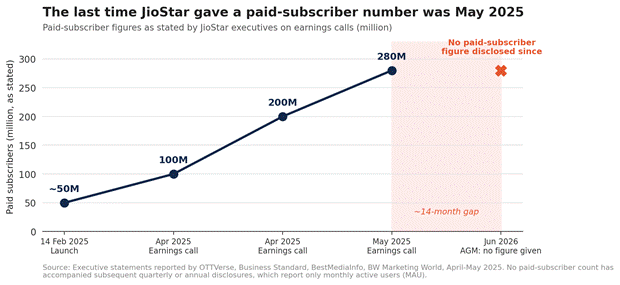
Paid-subscriber figures as stated by JioStar executives on earnings calls. No figure has accompanied any disclosure since May 2025.
2. Quarterly filings show profit falling for two straight quarters while the audience kept growing.
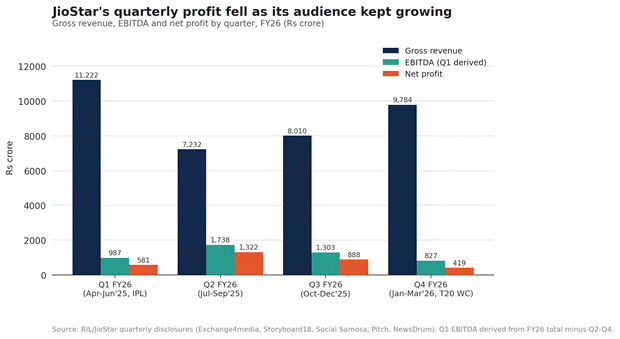
Gross revenue, EBITDA and net profit by quarter, FY26 (₹ crore).
3. Margin compression, mapped against the MAU growth happening at the same time.
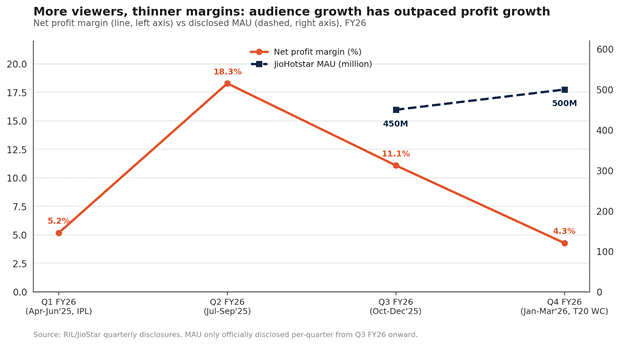
Net profit margin (line, left axis) vs disclosed MAU (dashed, right axis), FY26.
4. The January 2026 repricing: a straight hike on Premium, a hidden one on Mobile.
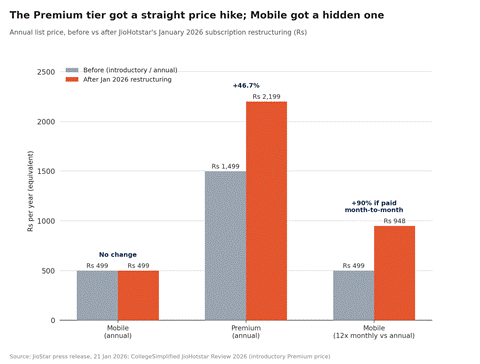
Annual list price, before vs after JioHotstar’s January 2026 subscription restructuring.
5. Even the most generous blended estimate of revenue-per-user lands well below list prices at Netflix.
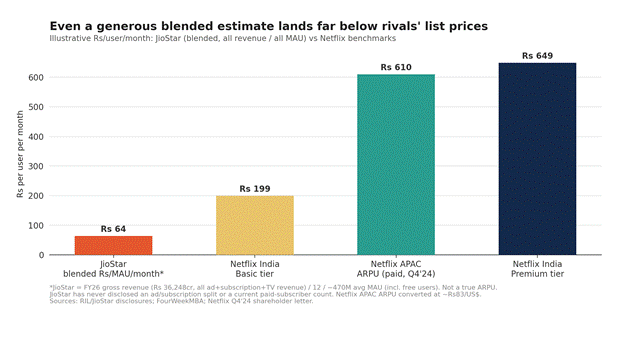
Illustrative ₹/user/month: JioStar (blended, all revenue ÷ all MAU) vs Netflix benchmarks.
Methodology & sources
All figures in this piece are drawn from public company disclosures, press releases, stock-exchange filings referenced in trade press, and named third-party data (Netflix’s own investor disclosures, Swiggy’s quarterly results). Where a figure could not be sourced directly and was calculated for illustrative purposes (Q1 FY26 EBITDA; the blended revenue-per-MAU estimate), this is explicitly flagged in the relevant chart. No private, leaked or off-the-record data was used.
Primary sources: Reliance Industries FY26 annual report and 49th AGM remarks; JioStar quarterly earnings disclosures as reported by Exchange4media, Storyboard18, Social Samosa, BestMediaInfo, Pitch, NewsDrum and myKhel; JioStar/JioHotstar official press releases (jiostar.com); Business Standard, OTTVerse and BW Marketing World reporting on paid-subscriber statements (April-May 2025); Swiggy Q4 FY26 results as reported by Storyboard18; Netflix Q4 2024 shareholder letter and third-party ARPU analysis (FourWeekMBA, DemandSage).
This is a data analysis based entirely on information already in the public domain. JioStar has not been approached for comment as part of this draft; any published version should include a right of reply before print.