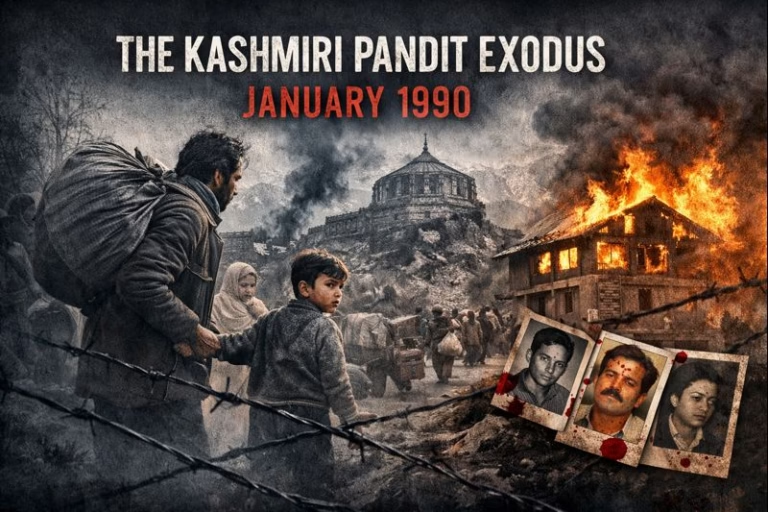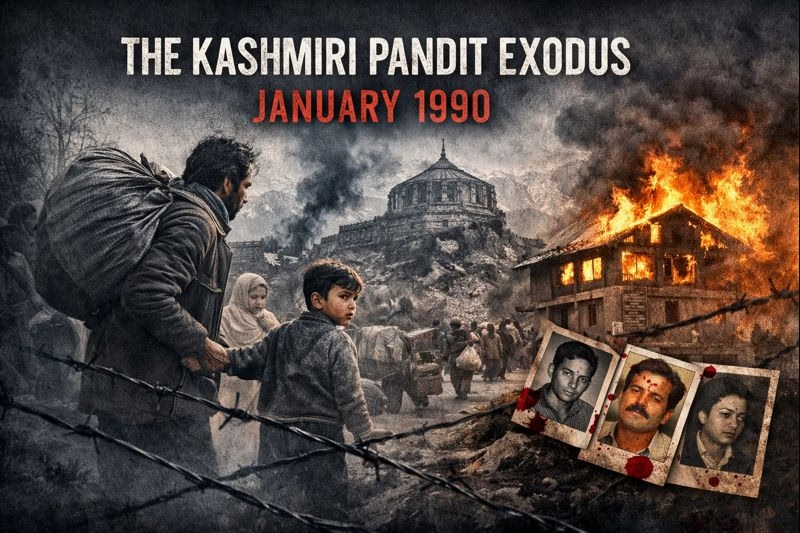
On and around 19 January 1990 a historic rupture accelerated in the Kashmir Valley: a rapid wave of targeted killings, threats and organised intimidation produced a mass flight of Kashmiri Pandits from the land their families had inhabited for centuries. Tens of thousands left with little more than what they could carry; their temples, neighbourhoods and livelihoods were disrupted, and an entire culture was scattered. This long read reconstructs the events, timelines and testimonies; identifies the principal perpetrators and institutional failures; and maps the continuing justice gaps that survivors and their descendants still confront. The narrative draws on human-rights investigations, contemporary reporting, survivor memoirs, and government and civil-society records.
Why January 1990 matters
For many Kashmiri Pandits, the phrase “January 1990” has become shorthand for the collapse of safety in the Valley. While violence had been rising through the late 1980s, the scale and coordination of threats and killings in early 1990 produced a panic that transformed localized incidents into mass flight. Scholarly and journalistic estimates put departures between roughly 90,000 and 150,000 people, a range reflecting different methods of counting but indicating a displacement on the order of an entire community uprooted almost overnight. Government tallies of fatalities vary, and human-rights organizations stress that counting deaths alone underestimates the trauma of dispossession, loss of property and rupture of cultural life.
Short primer: the political context
To read January 1990 in isolation is to miss the preceding political currents. A disputed 1987 state election, growing alienation, the rise of armed insurgency in the Valley and the entry of cross-border support for militant outfits all combined to create a rapidly deteriorating security environment in the late 1980s. Militant groups, some with local roots, others with external backing or agendas, increasingly targeted symbols of the state, government employees and those perceived as collaborators. Because Kashmiri Pandits were over-represented among local government workers, teachers and clerks, they were disproportionately exposed to these reprisals. At the same time, measures of state control and civilian policing were uneven in many rural pockets, weakening ordinary protection.
The mechanics of intimidation and the tipping point
What turned spreading fear into mass flight were several interlocking dynamics:
- Targeted killings of Pandit individuals (teachers, clerks, priests, professionals) that were public and often framed as punishments for collaboration. These killings were reported widely and created an atmosphere in which staying felt increasingly dangerous.
- Public threats and leaflets circulated by militant groups (reported in contemporaneous press and government briefings), warning minority communities or those associated with the Indian state to leave. Those warnings, even when not strictly enforced everywhere, carried a weight far beyond their literal text.
- State protection gaps, in many areas the local police and civil administration were overmatched or in retreat; this institutional vacuum magnified the sense that once targeted, families had no reliable guarantor of safety.
These dynamics reached a crisis point in January 1990 as killings escalated and whole neighbourhoods emptied in a matter of days. Survivors describe convoys leaving at night, long queues at bus stands and ad-hoc arrangements to shelter relatives in Jammu, Delhi and other cities.
Voices from the wreckage
Memoirs and interviews give human texture to the headline statistics. Rahul Pandita, a Kashmiri Pandit journalist and author of the widely read memoir Our Moon Has Blood Clots, captures the bewilderment and rupture of that time: “I remember the day when I realised I had no memory of her voice… There were many houses for sale in the newspapers; people were selling houses overnight,” he writes, evoking the surreal, abrupt exodus and the long-term feeling of loss. Such memoirs are essential primary sources for the patterns documented here, and they are corroborated by multiple survivor interviews recorded by journalists and human-rights investigators.
After the 2003 Nadimarg massacre, multiple survivors and villagers told reporters about the shock of being targeted years after the initial exodus, a reminder that even those who remained or attempted to return were vulnerable. Contemporary press accounts of the Nadimarg massacre include direct testimony from relatives and neighbours about the manner of the killings and the terror that followed.
Human Rights Watch collected victim and witness accounts across years of research, documenting both militant attacks and the broader pattern of impunity that left many crimes unpunished. Those field interviews, with displaced families, local residents, and some returnee, form an evidence base for the narrative below.
Timeline: Kashmiri Pandit Exodus & Targeted Violence
Key events leading to the displacement, massacres, and aftermath (1987–2003)
Disputed Jammu & Kashmir State Elections
Allegations of large-scale rigging fuel political alienation in the Valley. Armed insurgency begins to take root, supported by external actors and local militant groups.
Escalation of Militancy
Targeted killings of government officials, intellectuals, and minority community members begin. Threat letters and intimidation campaigns spread fear among Kashmiri Pandit families.
Mass Exodus of Kashmiri Pandits
Following assassinations, public threats, and complete breakdown of security, tens of thousands of Kashmiri Pandits flee the Valley. January 19 becomes symbolic of forced displacement and exile.
Life in Exile
Displaced families live in refugee camps and temporary settlements in Jammu, Delhi, and other cities. Property left behind is destroyed, occupied, or lost.
Sangrampora Massacre
Seven Kashmiri Pandits are killed in Sangrampora village. The attack deepens fear among families considering return.
Wandhama Massacre
Twenty-three Kashmiri Hindus, including women and children, are killed in Wandhama village. The massacre shocks the nation and reinforces the impossibility of safe return.
Prankote / Dakikote Killings
Hindu villagers in remote areas of Udhampur district are killed. Reports describe extreme brutality, including beheadings and arson.
Nadimarg Massacre
Twenty-four Kashmiri Pandits are lined up and shot dead by militants disguised in security uniforms. The massacre ends hopes of large-scale return.
Unfinished Justice
Sporadic investigations, arrests, and compensation schemes occur, but most cases remain unresolved. The demand for justice, recognition, and safe return continues.
(Each of these entries is extensively documented in contemporary press reporting, human-rights dossiers, and later compilations.)
A detailed chronology of notable incidents (1990–2004)
Below is a sequential list of key incidents that either triggered displacement, deterred return, or indicated the pattern of targeted violence:
- Early 1990 — wave of targeted killings and threats: Multiple reports from 1990 document murders of Pandit professionals and threats that precipitated mass departures. Contemporary press and later scholarly surveys describe teachers, clerks and local officials being singled out.
- 21 March 1997 — Sangrampora massacre (7 killed): Seven Kashmiri Pandit villagers were found shot dead in Sangrampora; local inquiry and media coverage recorded both the atrocity and the frustration at the case being officially classified as ‘untraced’.
- 25 January 1998 — Wandhama massacre (23 killed): A massacre in Wandhama left 23 dead, including women and children; domestic and international press reported militants’ alleged involvement and the chilling effect on returnees.
- 17 April 1998 — Prankote/Dakikote killings (Udhampur/Reasi area): Reported beheadings and burning of houses in remote hamlets; coverage described survivors’ accounts of forced conversions and executions, though reports and casualty figures vary across sources.
- 23 March 2003 — Nadimarg massacre (24 killed): Gunmen in army uniforms entered Nadimarg and executed 24 minority villagers. The massacre attracted widespread condemnation and was covered by major outlets like The New York Times and The Guardian; investigators attributed the attack to Lashkar-e-Taiba operatives. The massacre underscored that even after the initial 1990 exodus, returning families remained vulnerable.
- 2000s — selective reopenings, prosecutions and continuing impunity: Over the following decades, some cases were re-investigated and a few perpetrators were arrested in relation to specific incidents. Yet human-rights groups repeatedly warned that impunity remained pervasive and that many families never saw closure or restitution.
Who carried out the attacks?
Attribution in conflict zones is often contested; that said, investigative reporting, security briefings and judicial filings have linked many of the mass attacks and organized campaigns of intimidation to militant groups operating in Kashmir, including Lashkar-e-Taiba and Hizbul Mujahideen, some of which received cross-border support. International diplomatic statements (e.g., U.S. and UK briefings) and later investigative threads in the press have repeatedly referenced cross-border ties as a material factor in militant capacity, while Indian investigative agencies and courts pursued suspects with alleged links to Pakistan-based handlers. The label “who did it” is legally and politically charged, but the weight of contemporaneous reporting and several later investigative threads point to organised militant groups as principal perpetrators of the attacks targeted at Pandits.
Institutional responsibility and the failure to protect
The Pandit exile is not merely the product of militant violence; it is also the story of protection failures. Human Rights Watch and other monitors documented:
- Gaps in policing and preventive protection in rural neighbourhoods.
- Slow, inconsistent investigations and a pattern of cases remaining untraced or unresolved; victims’ families often complained of official indifference.
- Broader counter-insurgency abuses and human-rights violations by multiple actors that together created a climate of insecurity for civilians.
Survivors repeatedly recount that when death threats arrived and killings began, many families sought official protection and felt it was insufficient, that was often what turned fear into flight.
The human cost: culture, property and multi-generational displacement
Beyond fatalities, the exodus produced long-term losses:
- Property and heritage: Houses and temple properties were left behind; many were illegally occupied or fell into disrepair. Legal pathways to reclaim or restore property have proven cumbersome.
- Cultural rupture: Rituals, custodianship of shrines, language and local music and cuisine that are integral to Pandit communal life were disrupted. Memoirs describe the daily intimacy of Kashmiri Pandit life abruptly broken.
- Socio-economic dislocation: Refugee colonies and makeshift housing in Jammu, Delhi and other cities created new vulnerabilities, overcrowding, job insecurity and loss of social capital.
Justice, remembrance and the political afterlife
For many displaced Pandits, justice remains incomplete. While some individual cases have seen renewed investigations or arrests, the larger suite of demands, transparent, speedy prosecutions, restitution of property, safe voluntary return programs and institutional apology or recognition, remains only partially met. Human rights groups insist on impartial investigations for all crimes (including abuses by security forces), and survivors demand concrete redress that goes beyond symbolic commemorations.
Political uses of memory, domestic electoral claims, cultural representation and films drawing on Pandit suffering, have sharpened public attention but have not resolved the day-to-day legal and material needs of survivors. Effective remediation would mix legal accountability (prosecutions where evidence supports it), administrative remedies (property-claim processes), and security guarantees (for any voluntary return to the Valley).
What would a credible path forward look like?
A durable, rights-based response would include:
- Transparent, expedited investigations into mass killings and targeted attacks, with independent oversight and witness protection.
- Legal pathways for property restitution or fair compensation, backed by clear administrative timelines and easily accessible grievance redress.
- Security guarantees for any return effort, not only token protection but sustained policing and community reconciliation programs.
- Memorialisation and documentation projects that respect victims’ dignity and avoid partisan instrumentalisation.
The winter of 1990did not end with a single headline; it initiated a multi-decade tragedy of displacement and fractured lives. The Kashmiri Pandits’ story is not merely one of blame or of pointing fingers; it is a call to reconstruct civic protections, to pursue impartial justice, and to restore what can be restored to families who still count themselves among the Valley’s displaced. Commemoration without accountability is incomplete; accounting without compassion is hollow. Both must be joined if the Valley’s pluralist fabric is to be genuinely repaired.
Select bibliography and source guide (representative)
- “Exodus of Kashmiri Hindus,” encyclopedic overview (summarises scholarly estimates and contemporary reporting).
- Human Rights Watch, Everyone Lives in Fear: Patterns of Impunity in Jammu & Kashmir, 2006 (field interviews, patterns of impunity and civilian testimonies).
- Amnesty International reports and petitions on human-rights violations in Jammu & Kashmir, 1990s–2000s.
- Contemporary press on Nadimarg massacre: The New York Times, The Guardian, Los Angeles Times.
- Rahul Pandita, Our Moon Has Blood Clots: A Memoir of a Lost Home in Kashmir — survivor testimony and lived detail.
- Incident pages and compiled lists (Wandhama, Sangrampora, Prankote) compiled in journalistic and reference summaries.
- JioHotstar’s 451 Million Users vs Its Shrinking Profit
- January of Exile: The Kashmiri Pandits, a forensic long read on flight, loss and the unfinished search for justice
- Kota’s Dummy Schools Are Dying — And Coaching Giants Should Be Worried
- When Confusion Follows the Exam: Why NEET 2025 Left Aspirants Looking for Credible Answers, and How Expert Guidance Can Help
- India’s Push to Become a Global Semiconductor Innovation Hub: Can It Succeed?